

Solutions of Exercise 7.1#
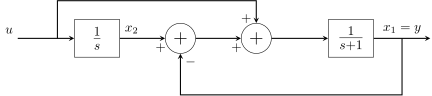
Fig. 61 Block diagram of the system#
Consider the system described in Fig. 61.
Write the system in state-space form, where the state variables \(x_1\) and \(x_2\) according to Fig. 61.
Design the state feedback control law \(u = - \ell_1 x_1 - \ell_2 x_2 + \ell_0 r\), where \(r\) is the reference signal, such that the closed-loop eigenvalues are in \(-4\) and \(-4\)
Suppose now that the only measurable signal is the output \(y\). Design a state observer such that the state estimation error has eigenvalues \(-6\) and \(-6\). How is the control law modified?
Write the resulting controller in the general linear feedback form.
Solution#
Question 1#
From Fig. 61 we can see that
Recalling that \(s\) is equivalent to the derivative operator in the Laplace domain, this is equivalent to
When it comes to \(X_1(s)\),
If we move \(-\frac{1}{s+1} X_1(s)\) to the left-hand side, we get
Summing the fractions in the parentheses we get
We then multiply both sides by \(s+1\), this becomes
Moving \(2 X_1(s)\) on the right-hand side, and recalling that \(s X_1(s) \rightarrow \dot{x}_1\), we finally get
The state-space form of the system is therefore
Question 2#
To design a state-feedback controller, we first need to assess whether (37) is controllable. To do that, let’s compute the controllability matrix:
This matrix is full-rank. Indeed, \(\det(\mathcal{S}) = 1 \neq 0\).
To design the state-feedback controller, we solve the pole placement problem. The closed-loop characteristic polynomial is
Mathing \(\varphi(\lambda)\) to the desired characteristic polynomial \(\varphi^\star(\lambda) = (\lambda + 4)^2 = \lambda^2 + 8 \lambda + 16\), we get
To compute the gain \(\ell_0\), we apply
The state feedback control law is therefore \(u = 4 x_1 - 10 x_2 + 16 r\).
Question 3#
Let’s design a state observer
Before designing the state observer, let’s check that the system is observable by computing the observability matrix
This matrix is full-rank. In fact, \(\det (\mathcal{O}) = 1 \neq 0\). We can therefore design the state-observer solving the pole placement problem. The characteristic polynomial of the state estimation error is
Matching \(\varphi(\lambda)\) to the desired characteristic polynomial \(\varphi^\star(\lambda) = (\lambda + 6)^2 = \lambda^2 + 12 \lambda + 36\), we get
The state-feedback control law is modified replacing \(x_1\) and \(x_2\) with \(\hat{x}_1\) and \(\hat{x}_2\), respectively:
Question 4#
Fig. 62 Block diagram of the generalized linear feedback#
The blocks \(F_r(s)\) and \(F_y(s)\) are computed as
Let’s compute them step-by-step
\(sI - A + KC + BL = \begin{bmatrix} s + 8 & 9 \\ 32 & s + 10 \end{bmatrix}\)
\((sI - A + KC + BL)^{-1} = \frac{1}{s^2 + 18s - 208} \begin{bmatrix} s + 10 & -9 \\ -32 & s+8 \end{bmatrix}\)
Therefore, the block \(F_y(s)\) reads
The block \(F_r(s)\) reads