

Solutions of Exercise 2.0#
Consider a second-order system \(G(s) = \frac{1}{s^2 + 3s + 2}\) and a proportional controller \(F(s) = 4\).
Draw the block diagram of the closed loop.
Does this controller ensure closed-loop stability?
Compute the steady-state output \(y(\infty)\) for step references with amplitude \(1\).
Compute the steady-state input \(u(\infty)\) for step references with amplitude \(1\).
Solution#
Question 1#
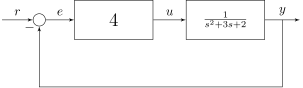
Question 2#
To check for asymptotic stability, we first find the closed-loop transfer function:
Therefore: $\( Y(s) = \underbrace{\frac{G(s) F(s)}{1 + G(s) F(s)}}_{G_c(s)} R(s) \)$
Let’s replace \(F(s) = 4\) and \(G(s) = \frac{1}{s^2 + 3s + 2}\). By so doing, we get $\( G_c(s) = \frac{4}{s^2 + 3s + 6} \)$
To assess whether the controller guarantees closed-loop stability, we compute the closed-loop poles, i.e., the roots of the denominator of \(G_c(s)\).
The closed-loop poles are complex-conjugate numbers. They are stable, because their real part is negative (\(-1.5 < 0\)).
Note
\(\sqrt{-15}\) is the square root of a negative number, and therefore an imaginary number. This has be re-written as follows
Question 3#
To compute \(y(\infty)\) we use the Final Value Theorem which states that
Final Value Theorem
The Final Value Theorem can be applied only if the (closed-loop) system is stable! In this exercise, we have checked it in Question 2.
Remembering that \(Y(s) = G_c(s) R(s)\), where the reference is \(r(t) = \textrm{step}(t)\) and its Laplace transform is \(R(s) = \frac{1}{s}\), we can compute \(y(\infty)\) as follows:
Question 4#
To compute \(u(t)\), we first compute its Laplace function, \(U(s)\).
Therefore, moving \(-F(s)G(s) U(s)\) on the left-hand side and dividing by \(1+F(s)G(s)\), we get: $\( U(s) = \frac{F(s)}{1 + F(s)G(s)} R(s) = \frac{4(s^2 + 3s + 2)}{s^2 + 3s + 6} R(s) \)$
Note that the poles of this transfer function are the same of \(G_c(s)\). Thus, it is stable. We can now apply the Final Value theorem: