

Solutions of Exercise 4.0#
We are given a mechanical system represented by the transfer function \(G(s)\). While an explicit expression for \(G(s)\) is not available, we have obtained its frequency response through a lot of hammer tests. The resulting frequency response is depicted in Fig. 20 below.
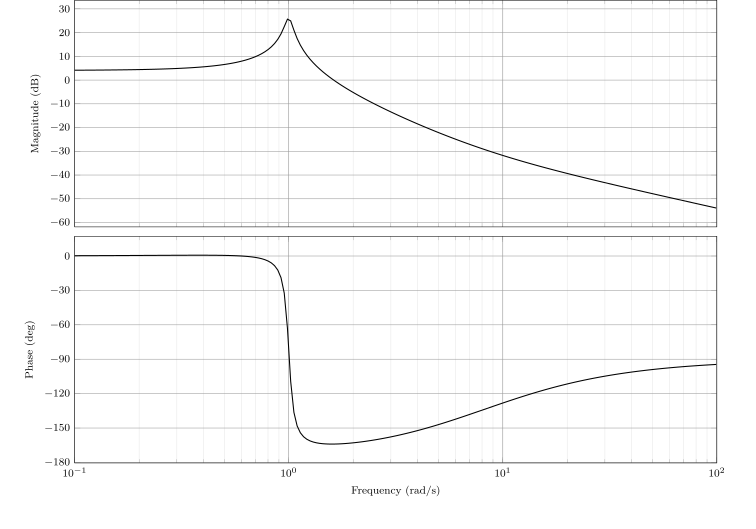
Fig. 20 Bode plot of the mechanical system \(G(s)\)#
Design a proportional controller \(F(s)=K\) such that the following specifications are satisfied:
The closed-loop is stable.
The bandwidth is greater than \(5\) rad/s, but it does not exceed \(15\) rad/s.
The phase margin \(\varphi_m\) is larger than \(45^\circ\).
What will be the worst-case resonance peak of the closed-loop transfer function \(G_c(s)\)?
Hint
Let the open-loop transfer function be \(G_o(s) = F(s) G(s)\). Then, its modulus and phase read
Solution#
Question 1#
Let’s start by noting that according to (8) and (9), the Bode plots of \(G_o(s)\) (and hence the closed-loop performance) can be inferred from the Bode plots of \(G(s)\) without actually knowing its analytical expression!
(8) implies that \(\lvert G_o(i \omega) \lvert_{\text{dB}}\) is obtained by shifting \(\lvert G(i \omega) \lvert_{\text{dB}}\) up/down by \(\lvert F(i \omega) \lvert_{\text{dB}} = K_{\text{dB}} = 20 \log_{10} K\)
(9) implies that \(\angle G_o(i \omega)\) remains unchanged, because \(\angle F(i \omega) = 0^\circ\) as long as \(K > 0\)
Note
The closed-loop bandwidth is approximately equal to the critical frequency of the open-loop transfer function \(G_o(i\omega)\), i.e., the frequency \(\omega_c\) where \(\lvert G_o(i \omega_c) \lvert_{\text{dB}}\) cuts the \(0\) dB axis.
Inspecting Fig. 20, we realize that \(\omega_c = 5\) if \(K_{\text{dB}} = 22\) dB. Similarly, \(\omega_c = 15\) if \(K_{\text{dB}} = 36\) dB. The resulting Bode plots of \(G_o(s)\) are repoted in Fig. 21.
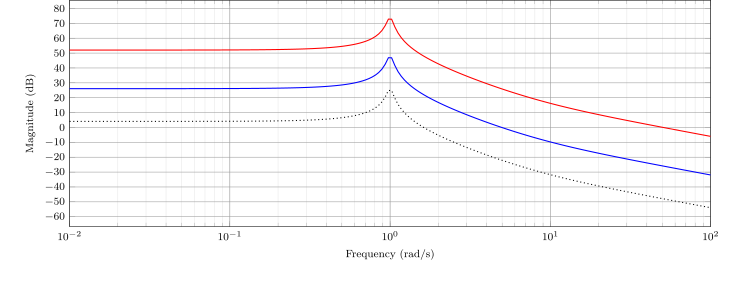
Fig. 21 Bode plot of \(G_o(s)\) for \(K_{\text{dB}} = 22\) dB (blue line) and for \(K_{\text{dB}} = 36\) dB (red line).#
Therefore, the range of gains statisfying the bandwidth requirement is
As for the phase, \(\angle G_o(i \omega) = \angle G(i \omega)\) for any \(K > 0\). Therefore, the phase margin \(\varphi_m\) is bigger than \(45^\circ\) as long as at the critical frequency \(\omega_c\), the phase satisfies \(\angle G(i \omega_c) > -135^\circ\).
Inspecting Fig. 20, we can see that this is the case as long as \(\omega_c < 1.1\) rad/s or \(\omega_c > 8\) rad/s. The former interval is not acceptable (it would violate the condition \(\omega_c > 5\)). The second condition, instead, is acceptable and translates to \(K_{\text{dB}} > 28 \) dB. Hence,
Solution: Any \(K\) in the range \(25 \leq K \leq 63\) satisfies the requirements.
Question 2#
As seen during the lecture F6, the closed-loop resonance peak satisfies
The worst-case resonance peak happens at the minimum phase margin, \(\varphi_m = 45^\circ\), at which \(M_p \geq 1.3\).