

Solutions of Exercise 4.3#
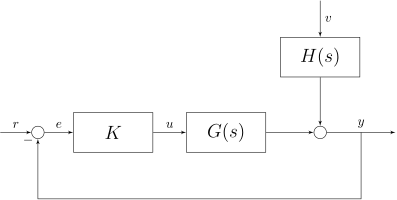
Fig. 28 Block diagram of a system affected by a disturbance \(v\)#
A system \(G(s) = \frac{5}{s+2}\) is affected by a disturbance \(v\) via a transfer function \(H(s) = \frac{s+10}{s+2}\).
The system is controlled with a proportional controller \(F(s) = K\), with \(K > 0\), as shown in Fig. 28.
For what values of \(K\) the closed-loop stability is guaranteed?
For what values of \(K\) the steady-state effect of a disturbance \(v = \text{step}(t)\) on the output is less than \(5\%\) in closed-loop?
Show how the control scheme can be changed to explicitly compensate the disturbance.
Solution#
Question 1#
The closed-loop transfer function is still
The closed-loop pole is in \(s = -2 - 5K\), which is negative for any \(K>0\).
Question 2#
To appreciate the effect of \(v\) on the output, we compute the transfer function between \(v\) and \(y\). We can ignore the reference at this stage (\(r=0\)) because of the superimposition principle.
The transfer function between \(V(s)\) and \(Y(s)\) is therefore
This transfer function is stable for \(K>0\) (it has the same poles of \(G_c(s)\)). Therefore, we can apply the Final Value Theorem to compute \(y(\infty)\) in response to \(v(t) = \text{step}(t)\), i.e., \(V(s) = \frac{1}{s}\).
The effect is less than \(5\%\) if
This is equivalent to
Mathematically, this is satisfied by \(2 + 5 K < - 200\) or \(2 + 5K > 200\), that is, \(K < - 40.4\) or \(K > 39.6\). The former solution must, however, be discarded because it would make the closed-loop unstable. Therefore, \(K > 39.6\).
Question 3#
The disturbance \(v\) is measurable, therefore we can use a feed-forward compensator \(F_{ff}(s)\) as in the figure below.
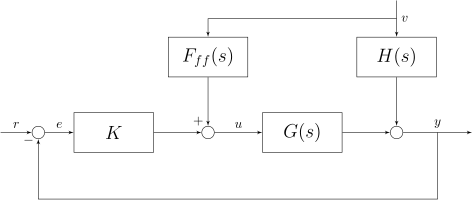
Fig. 29 Control scheme with feed-forward disturbance compensator, \(F_{ff}(s)\).#
In order to design this compensator \(F_{ff}(s)\), we can write down the closed-loop transfer function with this additional control action.
In this case, the transfer function between \(V(s)\) and \(Y(s)\) is
An ideal compensator \(F_{ff}^{\star}(s)\) is one that makes the transfer function null, so that \(Y(s) = 0 V(s)\) for any possible \(V(s)\). This is achieved if
Which means
Warning
This feed-forward controller \(F^{\star}_{ff}(s)\) cannot be implemented, because its transfer function is non-proper (it has more zeros than poles).
In practice we would implement a static compensator