

Solutions of Exercise 6.3#
Consider the system in Fig. 59.
Find the state-space form of the system, where the states are \(x_1\) and \(x_2\) given in the figure.
Compute a state-feedback controller for the state-space system defined in question 1, so that
The closed-loop eigenvalues are placed in \(-4\)
The static gain is exactly \(1\)
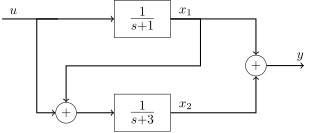
Fig. 59 Block diagram of the system#
Solution#
Question 1#
Remembering that \(s X(s)\) is equivalent to the derivative in the time domain, we can write
\( X_1(s) = \frac{1}{s+1} U(s) \quad \rightarrow \quad (s+1) X_1(s) = U(s) \quad \rightarrow \quad \dot{x}_1(t) + x_1(t) = u(t) \)
The first state evolves according to \(\dot{x}_1 = - x_1 + u\).
When it comes to the second state,
\( X_2(s) = \frac{1}{s+3} (U(s) + X_1(s)) \quad \rightarrow \quad (s+3) X_2(s) = U(s) + X_1(s) \quad \rightarrow \quad \dot{x}_2 = x_1 - 3 x_2 + u \)
Noting that \(y = x_1 + x_2\), we can finally write the state-space system as
Question 2#
To design a state-feedback controller \(u = - L x + \ell_0 r\), we first need to check the controllability of the system
This matrix is full rank (\(\det(\mathcal{S}) = -1 \neq 0\)), which means that the system is controllable. We can therefore design the state feedback controller, and we start by the gain \(L\).
Under the control law \(u = - Lx + \ell_0 r\), the closed-loop system is
\( \dot{x} = A x + B (-Lx + \ell_0 r) = (A - BL) x + B \ell_0 r \)
The poles of the closed-loop are the eigenvalues of \(A-BL\) which, of course, depend upon the controller’s parameters, \(L = \begin{bmatrix} \ell_1 & \ell_2 \end{bmatrix}\). To design the controller, we first write the characteristic polynomial of the closed-loop:
To find \(\ell_1\) and \(\ell_2\), we set the coefficients of this polynomial equal to the coefficients of the desired characteristic polynomial, i.e., the polynomial whose roots match the desired poles (\(-4\) and \(-4\)):
By setting the coefficients of (29) and (30) equal, we get
From the first equation we get \(\ell_1 = 4 - \ell_2\). Substituting this int othe second equation we obtain
\( 3 + 3(4 - \ell_2) + 2 \ell_2 = 16 \quad \rightarrow \quad -\ell_2 = 16 - 15 \quad \rightarrow \quad \ell_2 = -1 \)
We can now replace this \(\ell_2\) in the expression of \(\ell_1\), thus obtaining \(\ell_1 = 4 - (-1) = 5\). The state-feedback gain is therefore
The last parameter to find is \(\ell_0\). We design \(\ell_0\) so that the closed loop transfer function has a static gain equal to one.
We now find \(\ell_0\) by enforcing \(G_c(0) = 1\).
Let’s compute \(\ell_0\) step-by-step.
\( A - BL = \begin{bmatrix} -1 & 0 \\ 1 & -3 \end{bmatrix} - \begin{bmatrix} 1 \\ 1 \end{bmatrix} \begin{bmatrix} 5 & -1 \end{bmatrix} = \begin{bmatrix} -6 & 1 \\ -4 & -2 \end{bmatrix} \)
\( (A - BL)^{-1} = \begin{bmatrix} -6 & 1 \\ -4 & -2 \end{bmatrix}^{-1} = \frac{1}{16} \begin{bmatrix} -2 & -1 \\ 4 & -6 \end{bmatrix} \)
\( \ell_0 = -\frac{1}{\frac{1}{16} \begin{bmatrix} 1 & 1 \end{bmatrix} \begin{bmatrix} -2 & -1 \\ 4 & -6 \end{bmatrix} \begin{bmatrix} 1 & 1 \end{bmatrix}} = -\frac{16}{\begin{bmatrix} 1 & 1 \end{bmatrix} \begin{bmatrix} -3 & -2 \end{bmatrix}} = \frac{16}{5} \)