

Solutions of Exercise 2.5#
We are trying to design the controller for the system:
Assume we go for a family of PI controllers described by the following transfer function, where \(K > 0\) is a parameter to be designed.
Compute the closed-loop transfer function \(G_c(s)\).
Apply the Routh-Hurwitz criterion to find for what values of \(K\) the system is stable.
Hint
Question 2 can be solved using the Routh-Hurwitz criterion.
The characteristic polynomial \(\Phi(s) = a^0 s^n + b_0 s^{n-1} + a_1 s^{n-2} + b_1 s^{n-3} + ...\) is the denominator of the system we are assessing the stability of. In this case, it is the denominator of \(G_c(s)\).
Note that the coefficients \(a_i\) and \(b_i\) are defined starting from the highest degree, \(s^n\), and they are “alternating”. \(b_n\) might be zero if \(n\) is an even number.
Solution#
Question 1#
The closed-loop transfer function is given by:
First, let’s compute the loop transfer function \(G_o(s) = F(s)G(s)\):
Now we can form \(G_c(s)\):
Simplifying the denominator:
Question 2#
Computing the Routh table#
Warning
Note that we could not solve this exercise computing the poles explicitly as in Solutions of Exercise 2.2. An alternative solution is based on the root locus.
The characteristic polynomial of the closed-loop system is the denominator of \(G_c(s)\):
We construct the Routh table, where \(a_0 = 1\), \(a_1 = 20\), \(a_2 = 5K\), and \(b_0 = 8\), \(b_1 = 25 + 5K\), \(b_2 = 0\).
\( \begin{array}{ccc} 1 & 20 & 5K \\ 8 & 25 + 5K & 0 \\ \hline c_1 & c_2 & 0 \\ d_1 & d_2 & 0 \\ e_1 & e_2 & 0 \end{array} \)
We remind that the coefficient \(c_k\) is computed as
We now compute the coefficients \(c_0\), \(c_1\), and \(c_2\).
To compute the coefficient \(d_k\), we just shift (4):
Then:
The \(e_k\) coefficients can be computed similarly:
Because \(d_1 =0\), \(e_0\) reads:
The remaining coefficients \(e_1 = e_2 = 0\).
Assessing the stability with the Routh criterion#
According to the Routh criterion, the system is stable if the element in the first column are all strictly positive.
\( \begin{dcases} 1 > 0 & (A) \\ 8 > 0 & (B) \\ \frac{135-5K}{8} > 0 \qquad & (C) \\ \frac{ 3375 + 230K - 25K^2}{135 - 5K} \qquad & (D)\\ 5K > 0 & (E) \end{dcases} \)
We now solve the inequalities one by one, and later reconstruct the system.
Inequality (A)
Satisfied \(\forall K\)
Inequality (B)
Satisfied \(\forall K\)
Inequality (C)
Because \(8\) is known and positive, we can get rid of it:
Inequality (D)
This is a fractional inequality. It is solved by computing the intervals where the numerator is positive, and the intervals where the numerator is negative. Then, we apply the rule of sign.
Numerator > 0
We change the sign and flip the inequality:
Then, we compute the roots, that specify the boundary of the interval
The discriminant is \(\Delta = 230^2 + 4 \cdot 25 \cdot 3375 = 390400 > 0\). Because the discriminant is positive, the system admits two real solutions:
Since the inequality had a \(<\), we conclude that the numerator is positive when \(-7.9 < K < 17.1\).
Denominator > 0
This inequality is satisfied for \(K < 27\).
Rule of signs
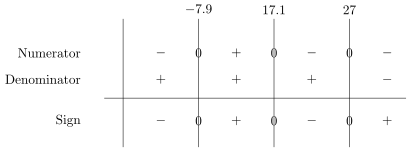
Inequality (D) was a \(>0\) inequality, therefore the solution is
Inequality (E)
Satisfied for \(K>0\).
Computing the interval#
We can finally reconstruct the system of inequalities (A)-(E)
\( \begin{dcases} \forall K \\ \forall K \\ K < 27 \\ -7.9 < K < 17.1 \cup K > 27 \\ K > 0 \end{dcases} \)
To find the largest interval that satisies all the inequalities at the same, we can sketch the intervals
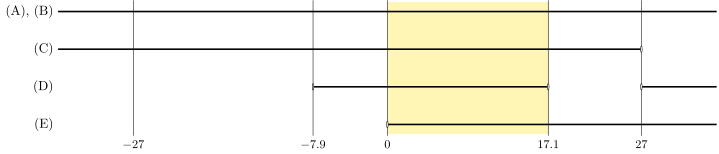
The interval of \(K\) for which the controller achieves closed-loop stability is \(\boxed{0 < K < 17.1 }\).